
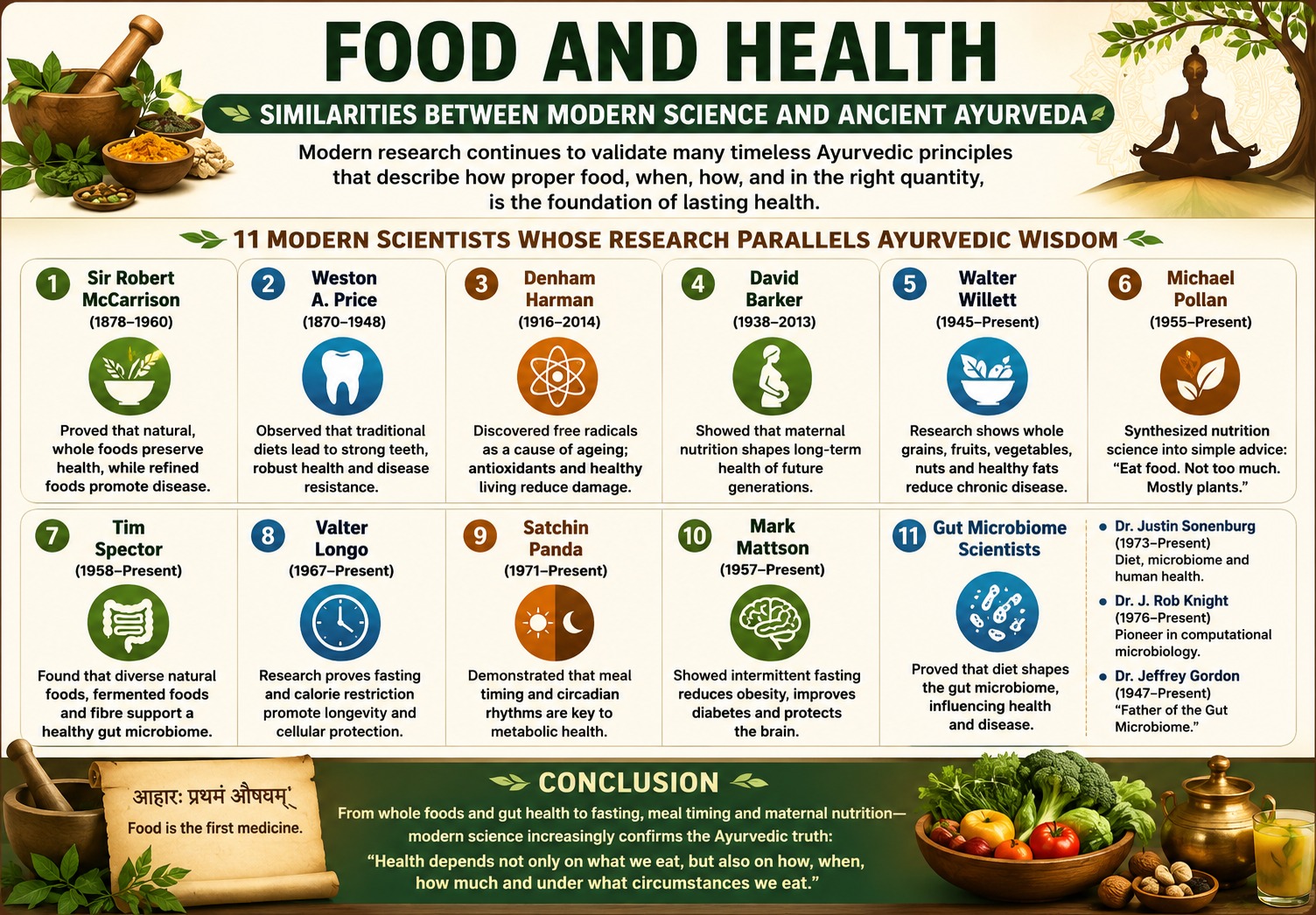
Similarities Between Modern Science and Ancient Ayurveda
During the last century, the science of food and nutrition has made tremendous progress. Numerous scientists have carried out extensive research over many decades and, through their painstaking efforts, have established many important principles relating to food and nutrition. Undoubtedly, we are deeply indebted to these scientists whose contributions have left an indelible mark on the field of medical science.
At the same time, we also owe an immense debt of gratitude to the ancient sages and scholars of India, who, thousands of years before modern scientific research began, had already described many of these principles in one form or another. Numerous Ayurvedic concepts concerning diet, digestion, food combinations, meal timing, and lifestyle have now received substantial support from modern scientific research. Remarkably, despite the enormous advances in nutritional science during the past century, no fundamental scientific discovery has invalidated the basic Ayurvedic principle that proper food is the primary determinant of health.
It is also worth remembering that the Ashtanga Hridayam was compiled by Acharya Vagbhata around the sixth or seventh century CE, whereas the two foundational Ayurvedic texts—Charaka Samhita and Sushruta Samhita—are believed to have been composed nearly one thousand years before the Common Era. These classical works continue to form the very foundation of Ayurveda.
An even more significant distinction is that modern nutritional science primarily focuses on the quantity and composition of nutrients in food, whereas Ayurveda does not regard the mere presence of nutrients as sufficient. According to Ayurveda, the Rasa (taste), Guna (qualities), Virya (potency), Vipaka (post-digestive effect), Agni (digestive power), quantity of food, timing of meals, seasonal suitability, and food compatibility (Viruddha Ahara) are equally important determinants of health. Thus, merely supplying the body with essential nutrients is not enough; their proper digestion, absorption, assimilation, and utilization are equally vital. It is precisely at this point that Ayurveda presents a broader and deeper perspective than modern nutritional science. While modern nutrition mainly explains what nutrients a food contains, Ayurveda also explains for whom, in which season, at what time, in what quantity, and under what conditions that same food will be beneficial or harmful.
The differences between modern nutritional science and ancient Ayurvedic science constitute an extensive subject in themselves and deserve a separate discussion. Therefore, this article focuses only on the remarkable similarities between the two.
Sir Robert McCarrison (1878–1960)
Sir Robert McCarrison established the Nutrition Research Laboratory at Coonoor (Tamil Nadu) in 1927 and devoted nearly three decades to nutritional research. The institution he founded later became part of the Indian Council of Medical Research (ICMR).
One of his most famous conclusions was:
“The fault is not in our genes, but in our food.”
McCarrison demonstrated that natural, whole foods preserve health, whereas refined foods promote disease, and that diet influences virtually every organ of the body. These observations closely parallel Ayurvedic principles discussed in our previous article.
Weston A. Price (1870–1948)
Weston A. Price travelled extensively across the world, studying traditional populations living on their native diets. He found that people consuming their traditional foods generally had excellent dental health, strong bones, and remarkable resistance to chronic diseases. However, once refined foods entered their diets, dental decay increased, obesity became common, diabetes appeared, and several serious diseases became prevalent.
His classic book, Nutrition and Physical Degeneration, provides compelling support for the ancient Ayurvedic warnings against processed and refined foods.
Denham Harman (1916–2014)
Denham Harman proposed the Free Radical Theory of Ageing, according to which unstable free radicals damage healthy cells by stealing electrons from them, thereby contributing to the ageing process. These free radicals are naturally produced during the body’s conversion of food into energy, while external factors such as smoking, pollution, and excessive environmental stress further increase their production.
Antioxidants such as Vitamins C and E help neutralize these harmful molecules, and a healthy diet combined with regular exercise can reduce oxidative damage.
For centuries, Ayurveda has emphasized nourishing foods, antioxidant-rich herbs, Rasayana (rejuvenation therapy), and healthy living to delay degeneration and promote longevity. Modern antioxidant research closely parallels these ancient Ayurvedic concepts.
David Barker (1938–2013)
David Barker introduced the Developmental Origins of Health and Disease (DOHaD) Hypothesis, demonstrating that maternal nutrition during pregnancy can influence an individual’s risk of disease many decades later.
Ayurveda has long emphasized the same principle through detailed descriptions of Garbhini Paricharya (antenatal care), maternal diet, and fetal nourishment, highlighting the lifelong importance of nutrition during pregnancy.
Walter Willett (1945–Present)
Professor Walter Willett of the Harvard School of Public Health has conducted extensive epidemiological research demonstrating that whole grains, fruits, vegetables, nuts, and healthy fats substantially reduce the risk of chronic diseases.
These findings are in remarkable agreement with Ayurvedic recommendations advocating fresh, wholesome, and naturally prepared foods for maintaining health.
Michael Pollan (1955–Present)
Although Michael Pollan is not a laboratory scientist, he has successfully synthesized the findings of thousands of nutrition studies into practical dietary advice. His well-known recommendation is:
“Eat food. Not too much. Mostly plants.”
This advice closely resembles the Ayurvedic principles of moderation in eating and a predominantly plant-based wholesome diet.
Tim Spector (1958–Present)
Tim Spector is a British epidemiologist, physician, and science writer whose research focuses on the relationship between nutrition, the gut microbiome, and human health. His studies have shown that consuming a wide variety of natural foods, fermented foods, and a fibre-rich diet promotes a healthy gut microbiome and improves overall health.
Ayurveda has emphasized a similar dietary approach since ancient times, advocating wholesome, naturally diverse foods to support digestion and maintain intestinal health.
Valter Longo (1967–Present)
Valter Longo is an Italian-American biogerontologist and cell biologist renowned for his research on cellular protection, ageing, fasting, and the influence of nutrients on gene expression. He is currently Professor of Gerontology at the USC Leonard Davis School of Gerontology, holds a joint appointment in the Department of Biological Sciences, and serves as Director of the USC Longevity Institute.
His pioneering research demonstrates that fasting and periodic calorie restriction (substantially reducing caloric intake on selected days of the week) can promote healthy ageing and longevity. These findings closely parallel the Ayurvedic concepts of Upavasa (fasting) and Langhana (light or reduced eating), which have long been recommended for preserving health and preventing disease.
Satchin Panda (1971–Present)
Satchin Panda is an Indian-American chronobiologist at the Salk Institute for Biological Studies whose work has significantly advanced the field of circadian biology. His research includes studies on melanopsin-mediated light sensing and Time-Restricted Eating (TRE), a dietary approach closely related to intermittent fasting.
Dr. Panda’s early research on melanopsin helped explain how light regulates the mammalian circadian clock. More recently, his laboratory has focused on the effects of circadian rhythms and time-restricted eating on metabolism and overall health. His work demonstrates that eating in harmony with the body’s biological clock improves metabolic health.
Ayurveda has emphasized appropriate meal timing in accordance with the body’s natural daily rhythms for thousands of years, making these modern findings strikingly consistent with classical Ayurvedic wisdom.
Mark Mattson (1957–Present)
Mark Mattson is an American neuroscientist and Adjunct Professor of Neuroscience at the Johns Hopkins School of Medicine. His research has demonstrated the benefits of intermittent fasting in reducing obesity, improving diabetes, and protecting against neurodegenerative diseases.
These findings provide further scientific support for the Ayurvedic principles of therapeutic fasting.
Scientists Studying the Gut Microbiome
Modern microbiome research is becoming increasingly consistent with Ayurveda’s long-standing emphasis on digestive health. Notable researchers in this field include:
- Dr. Justin Sonnenburg (1973–Present)
Professor of Microbiology and Immunology at Stanford University, whose research focuses on the interaction between diet, the gut microbiome, and human health. - Dr. J. Rob Knight (1976–Present)
A distinguished computational biologist and microbiologist from New Zealand, currently Professor at the University of California, San Diego (UCSD), and Founding Director of the Center for Microbiome Innovation. He is internationally recognized for his pioneering work in computational microbiology and his leadership in major scientific initiatives such as the Human Microbiome Project. - Dr. Jeffrey Gordon (1947–Present)
A renowned American physician and biologist widely regarded as the “Father of the Gut Microbiome.” His pioneering research has demonstrated how intestinal bacteria profoundly influence human health and disease.
Collectively, the work of these scientists demonstrates that the composition and function of the gut microbiome are strongly influenced by diet. Ayurveda has long expressed a similar concept through its emphasis on Agni (digestive fire), healthy digestion, and the production of wholesome versus harmful metabolic by-products.
Conclusion
Many modern scientific discoveries—including the importance of whole foods, meal timing, fasting, gut health, circadian rhythms, and maternal nutrition—show remarkable parallels with principles described in Ayurveda thousands of years ago. Although modern nutritional science and Ayurveda differ in their philosophical foundations and methodologies, contemporary research increasingly supports many of Ayurveda’s fundamental dietary concepts.
The central Ayurvedic doctrine—that appropriate food is the foundation of good health—has repeatedly found support in modern scientific evidence. While science continues to refine our understanding of the mechanisms involved, the enduring wisdom of Ayurveda reminds us that health depends not merely on what we eat, but also on how, when, how much, and under what circumstances we eat.