
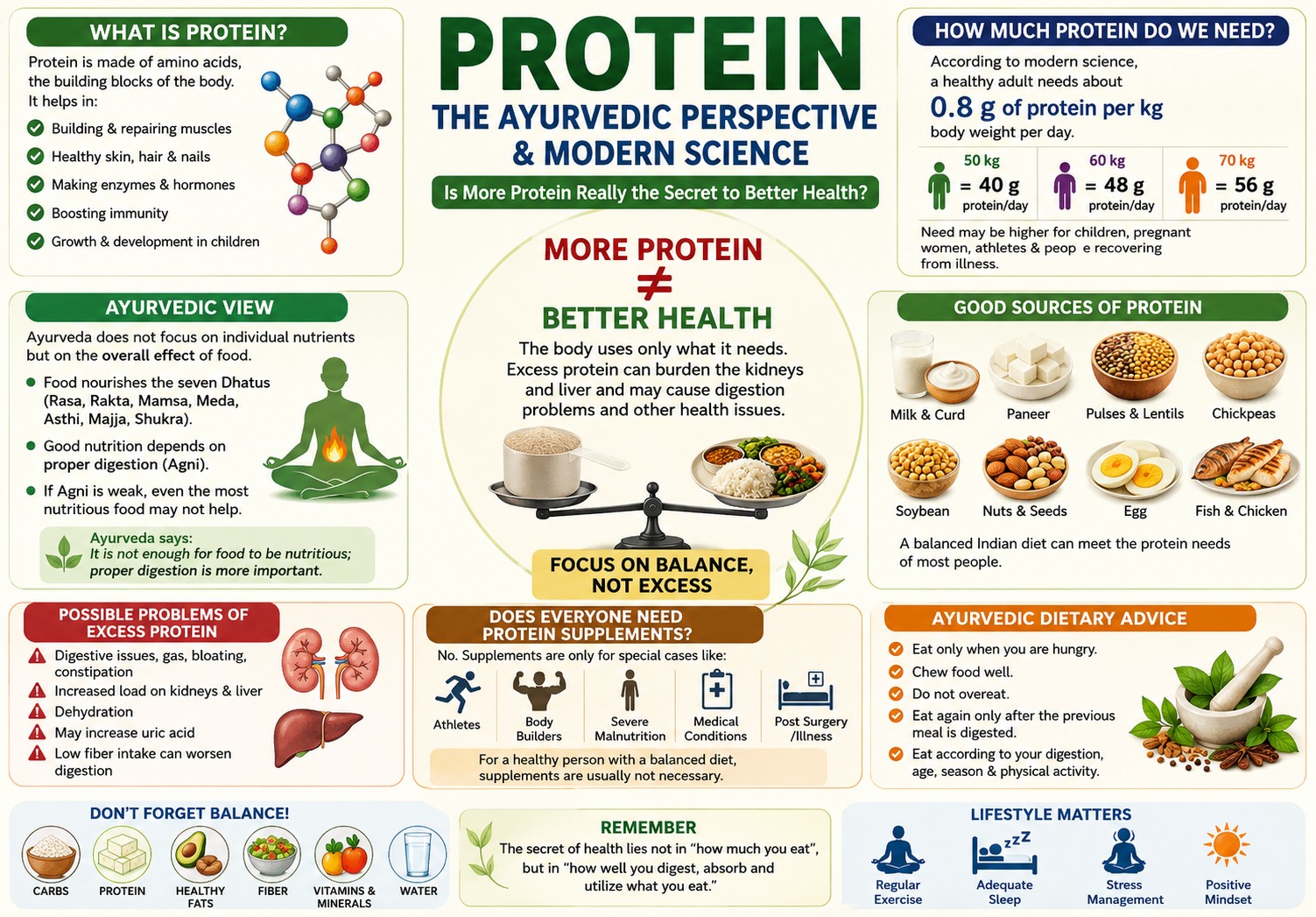
Protein: Ayurveda and Modern Science
Is More Protein Really the Secret to Better Health?
Nowadays, there is a lot of promotion of “high-protein diets.” From people who go to the gym to ordinary individuals, people have started using protein powders, high-protein snacks, supplements and even high protein diet. It is believed that the more protein one eats, the more strength, muscles, and health one will get.
But is this really so?
Modern science and Ayurveda—both agree that protein is essential for the body, but protein taken in quantities more than required is not beneficial. The body needs only as much protein as it can digest and utilize.
Let us understand this in simple language from the perspectives of both Ayurveda and modern science.
What is Protein?
Protein is an important nutrient for the body. It is made up of amino acids, which are called the “building blocks” of the body.
Protein performs many important functions in the body—
- Building and repairing muscles
- Formation of skin, hair, and nails
- Production of enzymes and hormones
- Maintaining immunity
- Helping in the growth and development of children
How Does Ayurveda View Protein?
The word “protein” is not mentioned in Ayurveda because when the ancient texts of Ayurveda were written, nutrients were not understood by separate names, but on the basis of the overall effect of food.
According to Ayurveda, the purpose of food is not merely to fill the stomach, but to properly nourish all seven Dhatus (Rasa, Rakta, Mamsa, Meda, Asthi, Majja, and Shukra).
When food is properly digested, the Ahara Rasa formed from it gradually nourishes all the Dhatus.
If digestion (Agni) is good, even ordinary food provides adequate nourishment. But if Agni is weak, even highly nutritious food cannot provide its full benefit to the body.
Therefore, Ayurveda says—
“Merely having nutritious food is not sufficient; digesting it properly is more important.”
Digestion Power (Agni) Is More Important Than Protein
In Ayurveda, Agni is considered the root of health.
If Agni is good—
- Food is digested properly.
- Nutrients are absorbed properly.
- The Dhatus are formed properly.
- Strength and Ojas increase in the body.
But if Agni is weak—
- Food remains partially undigested.
- “Ama” (toxic undigested substances) begins to form.
- The body does not receive complete nourishment.
- Various diseases begin to develop.
Therefore, instead of taking only more protein, it is more important to improve digestive power.
How Much Protein Does the Body Need?
According to modern science, a normal healthy adult requires approximately 0.8 grams of protein per kilogram of body weight per day.
For example—
- A person weighing 50 kilograms needs approximately 40 grams.
- A person weighing 60 kilograms needs approximately 48 grams.
- A person weighing 70 kilograms needs approximately 56 grams.
of protein per day is sufficient.
However, children, pregnant women, breastfeeding mothers, athletes, and people recovering from serious illness may require somewhat more.
Is Sufficient Protein Obtained from a Normal Indian Diet?
Yes.
If the diet is balanced, the requirements of most people are fulfilled through normal food.
Good sources of protein are—
- Milk and curd
- Paneer
- Pulses
- Chickpeas
- Kidney beans
- Cowpeas
- Soybeans
- Moong
- Urad
- Peas
- Peanuts
- Sesame
- Almonds
- Eggs
- Fish
- Chicken
If an appropriate balance of these foods is maintained throughout the day, most people do not require protein powder/supplements separately.
Is Plant-Based Protein Sufficient?
Yes.
By consuming a balanced combination of legumes, grains, milk, and nuts, most of the essential amino acids are obtained.
For example—
- Dal + rice
- Khichdi
- Roti + dal
- Chickpeas + wheat
- A balanced meal with milk
These combinations provide good nutrition to the body.
Is Eating More Protein Beneficial?
It is a common misconception that the more protein one eats, the more muscles will be built.
In reality—
The body uses only as much protein as it requires.
Excess protein—
- may be stored in the form of fat.
- and the kidneys and liver have to perform the additional work of eliminating its waste products.
Possible Harmful Effects of Excessive Protein Intake
If more protein than required is consumed for a long period, especially in the form of supplements, the following problems may occur—
- Digestive problems
- Constipation
- Gas
- Bloating
- Dehydration
- Additional workload on the kidneys (the main cause of kidney diseases)
- Possibility of increased uric acid and becoming a cause of diseases such as gout, etc.
- If fiber in the diet becomes low, constipation and intestinal problems
Should Everyone Take Protein Supplements?
No.
Protein powders may be useful only in special circumstances, such as—
- In athletes
- In bodybuilders
- Severe malnutrition
- On medical advice
- After major surgery or serious illness
If a normal healthy person is receiving a balanced diet, protein supplements are not required; rather, the risk of kidney diseases increases.
What Does Ayurveda Advise?
The main message of Ayurveda is—
- Eat only when you feel hungry.
- Eat food after chewing it properly.
- Do not overeat.
- Eat the next meal only after the previous meal has been digested.
- Take food according to your digestive power.
- Make changes in your diet according to the season, age, and physical exertion.
In other words, health is not merely about increasing protein in the diet; digestion, balance, and appropriate quantity are more important.
Think About This with a Calm Mind:
1.How does a newborn baby, from birth through infancy (as long as the baby’s diet consists only of milk), grow without any additional protein?
Not only does growth take place, but all the organs of the body (including the brain) also develop solely from milk.
2.Do children (from birth to adolescence, when the body is developing) require more protein, or do adults require more protein, who need it not for development but only for maintenance, and how much will their requirement depend on their physical activities?
If protein is consumed in excess of the requirement, will it be properly digested, and will partially digested protein provide benefit or harm to the body?
3.How appropriate is it to focus only on protein for proper nutrition and digestion?
In addition to protein, should the quantity and type of fat and fiber also be considered or not?
All non-vegetarian foods, including eggs, and paneer contain a lot of fat.
Paneer contains more fat than protein.
At the same time, all non-vegetarian and dairy products contain absolutely no fiber, and digestion cannot take place properly without fiber.
4.Our body requires only 20% of its required calories from fat.
For people who perform more physical labor, this can be up to 35% in proportion to the amount of physical labor.
The amount of fat in paneer and non-vegetarian foods is naturally much higher than this, and the fat used in cooking them makes the situation even worse.
5.Similarly, an adult person requires 35 to 38 grams of fiber, which can be up to 45 grams in people who consume 2 to 3 liters of water/liquids (which is always recommended).
Without this, digestion cannot take place properly.
6.Excessive intake of fat inevitably leads to obesity and related diseases, while low fiber inevitably leads to digestive disorders.
Conclusion
Protein is an extremely essential nutrient for our body, but the belief that “more protein = better health” is not correct.
Modern science tells us that the protein requirements of most healthy people are fulfilled through a normal balanced diet.
On the other hand, Ayurveda teaches us that food provides benefit only when it is properly digested and the body is able to transform it into nourishment for the Dhatus.
In a balanced diet, proper coordination of carbohydrates, protein, fat, vitamins, minerals, and fiber is essential; therefore, the basic mantra for staying healthy is not merely eating more protein, but adopting a balanced diet, strong digestive power, regular exercise, adequate sleep, and a healthy lifestyle.
Remember— the secret of health lies not merely in “how much you ate,” but in “how much was digested and how much the body utilized.”