
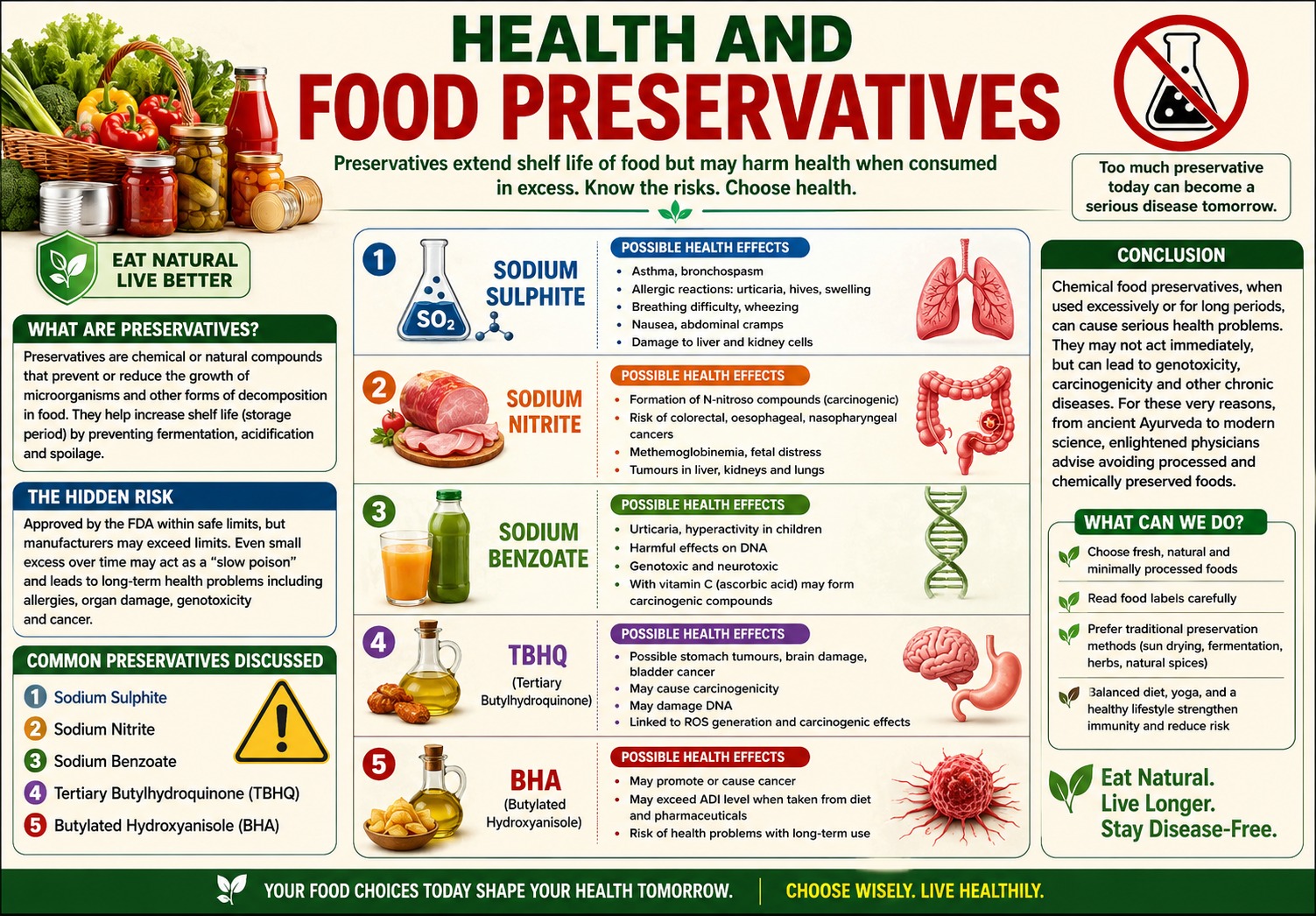
Preservatives are chemical or natural compounds that help prevent the growth of microorganisms, thereby helping to prevent food products from spoiling quickly and also helping to increase their shelf life (storage period). They do this by preventing or reducing fermentation, acidification, or other forms of decomposition in food products.
Thus, food preservatives appear to be very attractive and useful, whereas they may also have serious adverse effects on health, which may be a cause of various diseases, including cancer. Our objective is to know and understand the adverse effects of chemical preservatives commonly used in food products.
Although the chemical preservatives used may be approved by the FDA, the FDA also determines the safe quantities in which they may be used, but manufacturers of preserved food products do not fail to violate these limits. In many circumstances, the use of an amount somewhat higher than the standard quantity may not even be detected in chemical testing. In addition, the fact that a substance that is inherently harmful may be safe in a limited quantity does not enter our ordinary understanding. Yes, rather than calling their effect “slow poison,” it appears more logical and acceptable to say that their effect may be long-term rather than immediate.
Since the number of these preservatives is extremely large, it is not possible to discuss all of them specifically here; therefore, we discuss some commonly used preservative substances, which are as follows:
- Sodium sulphite
- Sodium nitrite
- Sodium benzoate
- Tertiary-butylhydroquinone (TBHQ)
- Butylated hydroxyanisole (BHA)
- Sodium Sulphite
Sulphite is a popular food preservative that is widely used in various food products as a bleaching agent and preservative. It is also used to prevent the oxidation of food products and to provide a product with a fresh smell and taste. Sodium sulphite, potassium bisulphite, and sodium bisulphite are some examples of these (El-Hefny et al., 2021).
Scientists have experienced several allergic reactions in individuals consuming sulphite-containing foods. Sulphite is a potentially fatal chemical that can enter the body through ingestion, inhalation, or by other routes. Several harmful and serious toxic effects of sulphite compounds have been found, including effects on liver and kidney cells (Mahmoud et al., 2015).
When sulphite comes into contact with stomach acids, SO₂ (sulphur dioxide) is formed. When the temperature is high and the pH is low, the formation of SO₂ increases. It can cause asthma in some people. In individuals sensitive to sulphite, it can also cause a health problem known as bronchospasm. Sulphite sensitivity is generally observed in patients with asthma, but sulphite-related health problems can also occur in individuals who do not already have asthma or other allergic disorders. Cases of death due to sulphite sensitivity have also been reported (Lester, 1995); (Rangan and Barceloux, 2009).
After eating sulphite-containing foods, allergic reactions such as urticaria, angioedema, hives and itching, skin redness, tingling, and swelling have been observed in some people. Respiratory symptoms may include difficulty in breathing, wheezing, and bronchoconstriction. Gastrointestinal symptoms may include nausea and abdominal cramps (Grotheer, Marshall and Simonne, 2005).
- Sodium Nitrite
Sodium nitrite is a preservative that is mainly used to preserve meat products. It gives meat products such as beef and sausages a bright red colour. During the meat preservation process, nitric oxide reacts with the meat pigment myoglobin and gives it a bright red colour. This combination forms a compound called nitrosomyoglobin, which is considered a carcinogenic compound (Ambarwati, 2012).
Long-term consumption of nitrite-containing processed meat has shown indications of the development of colorectal cancer (Crowe et al., 2019).
Long-term exposure to N-nitroso compounds can cause oesophageal carcinoma. Nitrites are also involved in the formation of N-nitroso compounds (Xie et al., 2011).
Sodium nitrite can produce aberrant crypts in the colon. Colonic aberrant crypts are considered potential pre-neoplastic lesions that occur before colon cancer. When nitrate is consumed, it is converted into nitrite. Nitrite can combine with haemoglobin to form methemoglobin. Methemoglobin can cause the risk of loss of consciousness and death, particularly in newborn infants (Anand and Sati, 2013).
It is possible that the use of sodium nitrite caused methemoglobinemia in the fetus, resulting in an increased need for new red blood cells (leading to fetal distress, growth restriction, or severe developmental issues). (Globus and Samuel, 1978).
Among the various chemical carcinogens identified in human food and beverages, N-nitroso compounds are considered extremely potent; they are generally formed by the combination of a secondary amino compound and nitrite (Lijinsky, 1999).
Nitrite is an active compound of nitric oxide, which is formed when nitrite dissolves. During meat preservation, nitric oxide combines with the meat pigment myoglobin and produces its bright red colour. The compound formed as a result is called nitrosomyoglobin, and it is considered a carcinogenic compound (Ambarwati, 2012).
Persistent reports of nasopharyngeal cancer have emerged from several Asian countries. NDMA (N-Nitrosodimethylamine) is found in bacon and other cured pork products, as well as in fish and seafood, and it is a causative factor for tumours (cancer) in the liver, kidneys, and lungs (Lijinsky, 1999).
- Sodium Benzoate
Sodium benzoate is a sodium salt that is mainly used as a preservative in juices and beverages. It helps prevent the growth of harmful bacteria, yeast, and fungi.
According to some reports, consumption of foods treated with sodium benzoate causes urticaria, hyperactivity in children, and harmful effects on DNA. Sodium benzoate is also considered genotoxic and neurotoxic and may be responsible for intercalation into the DNA structure (Bruna et al., 2018).
It has also been found that long-term use of food products treated with sodium benzoate, when combined with vitamin C or ascorbic acid, may result in the formation of carcinogenic compounds (Samal et al., 2017).
In the genotoxicity test, substances have been identified that cause genetic damage and produce carcinogenic compounds.
- Tertiary Butylhydroquinone (TBHQ)
Tertiary butyl hydroquinone is a food preservative that is widely used in fats and oils and in some meat products because of its high anti-lipid-peroxidation capacity. It helps prevent rancidity in food products and increases their shelf life. It also acts as an antioxidant and prevents discoloration in iron-containing foods.
Consumption of foods containing tBHQ may cause the possibility of stomach tumours, brain damage, and bladder cancer. Recent studies indicate that the use of tBHQ may cause carcinogenicity (Eskandani et al., 2014).
Several studies have shown that the use of tBHQ may cause stomach tumours and may damage DNA (Dolatabadi and Kashanian, 2010).
The oxidized forms of tBHQ, semiquinone anion radicals, and the metabolic production of ROS generation are related, at least in part, to its reported carcinogenic effects (Gharavi et al., 2006).
- Butylated Hydroxyanisole (BHA)
Butylated hydroxyanisole is a food preservative that is mainly used in oils and fats. It is a phenolic antioxidant. It prevents lipid oxidation and thereby prevents rancidity (off-odour, staleness/bad smell) in oils and fats. BHA is also used in dry foods and cereals. It helps maintain the freshness, colour, and nutritive value of food products.
BHA is also present in pharmaceuticals. If a person consumes both dietary and pharmaceutical products every day, the intake of BHA may exceed the ADI level (Anca et al., 2013).
Several studies conducted on BHA have shown that it may promote or cause cancer. The possibility of health problems may arise due to consumption of products containing this preservative.
Conclusion
The present review shows that the use of chemical food preservatives in food products can cause several serious health problems. The problems caused by them depend on the quantity of the respective preservative and the duration of its use. Some preservatives may not act directly, but they may nevertheless promote or cause several health problems such as genotoxicity and carcinogenicity. For these very reasons, from the ancientmost Ayurveda to the most modern science, enlightened physicians all prohibit the consumption of processed food products.