
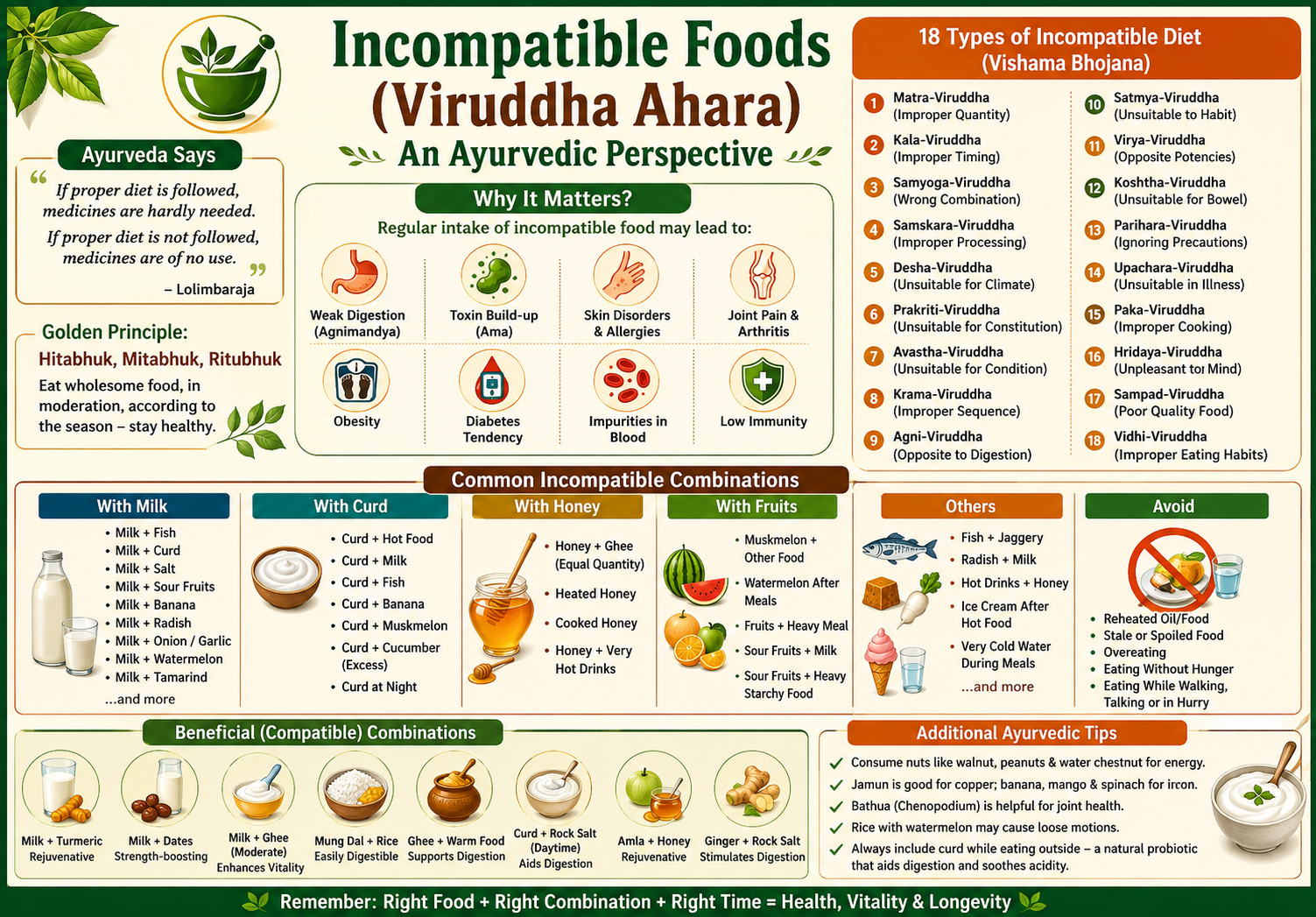
INCOMPATIBLE FOODS
Visham or Viruddha
Ahara: An Ayurvedic Perspective
The purpose of this article is not to create fear, but to
highlight the importance of proper food combinations (food compatibility).
Habitually following suitable dietary combinations can not only enhance the
body’s natural immunity but may also help prevent many chronic diseases.
The close relationship between food and health has been
emphasized in Ayurveda for centuries. In his famous work Vaidya Jeevan,
the Ayurvedic scholar Lolimbaraja (About 1538-1608 ) writes:
पथ्ये सति गदार्तस्य किमौषधनिषेवणैः।
पथ्येऽसति गदार्तस्य किमौषधनिषेवणैः॥
That means : “If a patient follows proper dietary rules and
wholesome food habits, medicines may hardly be needed. Conversely, if proper
dietary discipline is not followed, medicines alone are unlikely to provide
lasting benefit because treatment cannot succeed without correcting the diet” .
Therefore, according to Ayurveda, proper diet and
self-discipline are the first and foremost medicines in the treatment of
disease particularly Chronic and Complex
diseases.
The Sushruta Samhita (Sutrasthana, Chapter 1)
describes food as the root of strength, complexion, vitality, and immunity.
Among the various means of maintaining and restoring health, food is given the
highest importance. It is also stated that a physician who understands the
nature of disease can often provide significant relief simply by prescribing an
appropriate diet (Pathya). In
Ayurveda, the term Pathya refers to foods and practices that are beneficial
to the body, easy to digest, and supportive of recovery from illness.
A famous Ayurvedic principle states:
“Hitabhuk,
Mitabhuk, Ritubhuk”
“हितभुक्, मितभुक्, ऋतुभुक्”
That means “person who consumes wholesome food, in moderate quantity, and according to the season
generally remains healthy” .
The Ayurvedic Concept of Incompatible Foods
The concept of Visham or Viruddha Ahara
(incompatible diet) is extensive and highly practical. In essence:
“It is not only important what we eat, but also when
we eat, how much we eat, with what foods it is combined, in which season it is
consumed, by whom it is consumed, and how it is prepared and eaten.”
According to Charaka, regular consumption of incompatible
foods may contribute to:
- Weak
digestive power (Agnimandya) - Formation
of Ama (toxic metabolic residues within the body) - Skin
disorders - Allergies
and itching - Impurities
of blood (Rakta Dosh) - Joint
disorders such as arthritis and rheumatism - Obesity
- Tendency
toward diabetes - Reduced
immunity
Ayurveda considers Vishama Bhojana (improper,
incompatible, or unsuitable eating habits) as a major cause of disease.
Classical texts such as the Charaka Samhita, Sushruta Samhita,
and Ashtanga Hridaya describe eighteen forms of dietary incompatibility.
Eighteen Types of Incompatible Diet (Vishama Bhojana)
No. | | |
1 | Matra-Viruddha (Improper Quantity) | Overeating, undereating, eating without hunger |
2 | Kala-Viruddha (Improper Timing) | Excessively spicy food in summer, cold drinks in winter, |
3 | Samyoga-Viruddha (Wrong Combination) | Combining foods that are considered incompatible |
4 | Samskara-Viruddha (Improper Processing) | Heating honey, repeatedly reheated ghee or oil, food (food |
5 | Desha-Viruddha (Unsuitable for Climate/Region) | Dry spicy food in arid regions, excessive fried foods in |
6 | Prakriti-Viruddha (Unsuitable for Constitution) | Foods contrary to one’s Vata, Pitta, or Kapha constitution |
7 | Avastha-Viruddha (Unsuitable for Current Condition) | Heavy meals or grains during fever, ice-cold water after sun |
8 | Krama-Viruddha (Improper Sequence) | Excess water before meals, fruit immediately after meals |
9 | Agni-Viruddha (Contrary to Digestive Capacity) | Heavy food with weak digestion, eating before previous |
10 | Satmya-Viruddha (Unsuitable to Habit) | Sudden adoption of unfamiliar foods- non veg by a |
11 | Virya-Viruddha (Opposite Potencies) | Combining foods with opposing heating and cooling |
12 | Koshtha-Viruddha | Foods unsuitable to bowel habits and digestive tendencies |
13 | Parihara-Viruddha | Ignoring required precautions after eating certain foods- |
14 | Upachara-Viruddha | Foods unsuitable during illness, sweets by obese, curd in |
15 | Paka-Viruddha | Improperly cooked foods- burned food, fried food, |
16 | Hridaya-Viruddha | Foods disliked by the mind or eaten with aversion, eating |
17 | Sampad-Viruddha | Poor-quality, stale, spoiled, or contaminated foods |
18 | Vidhi-Viruddha | Improper eating habits such as eating too fast or while standing, walking or talking |
Important Incompatible Food Combinations
Milk-Based Incompatible Combinations
Combination | Ayurvedic Reason |
Milk + Fish | Opposing qualities (hot-cold and properties incompatibility) |
Milk + Curd | Different digestive processes |
Milk + Salt | Believed to contribute to blood and skin disorders |
Milk + Sour Fruits | Causes very fast curdling and impaired digestion |
Milk + Lemon | Digestive disturbance |
Milk + Tamarind | Opposing potency |
Milk + Orange/Sweet Lime | Kapha aggravation |
Milk + Banana | Heavy and mucus-forming |
Milk + Muskmelon | Digestive incompatibility |
Milk + Watermelon | May weaken digestive fire |
Milk + Jackfruit | Heavy and difficult to digest |
Milk + Radish | Possible skin disturbances |
Milk + Garlic | Opposing qualities |
Milk + Onion | Digestive disturbance |
Milk + Horse Gram | Considered incompatible |
Milk + Urd Dal | Excessively heavy |
Milk + Fermented Foods | Digestive interference |
Milk + Vinegar | Incompatible combination |
Curd-Based Incompatible Combinations
Combination | Reason |
Curd + Hot Foods | May aggravate Pitta |
Curd + Milk | Incompatible |
Curd + Fish | Traditionally associated with skin disorders |
Curd + Muskmelon | Difficult digestion, toxic effect |
Curd + Banana | Kapha increase |
Curd + Excess Cucumber | Digestive disturbance |
Curd at Night | Kapha aggravation |
Honey-Related Incompatible Combinations
Combination | Reason |
Honey + Ghee in Equal Quantities | Described by Charaka as potentially harmful |
Heated Honey | Considered toxic in Ayurveda |
Cooked Honey | Improper processing |
Honey + Very Hot Drinks | Loss of beneficial properties |
Fruit-Related Incompatible Combinations
Combination | Reason |
Muskmelon + Other Foods | Different digestion rate |
Watermelon Immediately After Meals | Digestive disturbance |
Fruits + Heavy Meals | Formation of Ama (Toxic effect) |
Sour Fruits + Heavy Starchy Foods | Fermentation tendency |
Sour Fruits + Milk | Incompatible combination |
Ghee, Oil and Fat-Related Combinations
Combination | Reason |
Honey and Ghee in Equal Quantities | Traditionally considered harmful |
Repeatedly Heated Ghee or Oil | Improper processing |
Food Repeatedly Fried in Reheated Oil | Difficult digestion and Ama formation |
Other Common Incompatible Combinations
Combination | Reason |
Fish + Jaggery | Traditionally considered incompatible |
Fish + Milk | Incompatible |
Radish + Jaggery | Dosha aggravation |
Radish + Milk | Possible skin disturbances |
Urd Gram + Radish | Heavy to digest |
Hot Drinks + Honey | Incompatible |
Very Cold Water During Meals | Weakens digestive fire |
Ice Cream Immediately After Hot Food | Digestive disturbance |
Equal Quantities of Water and Honey (certain preparations) | Mentioned as unsuitable in some texts |
Beneficial Food Combinations in Ayurveda
Combination | Benefit |
Milk + Turmeric | Rejuvenative |
Milk + Dates | Strength-promoting |
Milk + Ghee (moderate quantity) | Enhances vitality and nourishment |
Mung Dal + Rice | Easily digestible complete meal |
Ghee + Warm Food | Supports digestion |
Curd + Rock Salt (daytime) | Aids digestion |
Amla + Honey | Rejuvenative |
Ginger + Rock Salt | Stimulates digestion |
Additional Dietary Observations
- Walnuts,
peanuts, and water chestnuts are often regarded as highly nourishing foods
and may provide more energy and nutrients than meat, egg and paneer. - Jamun
(Indian blackberry) contains copper; bananas, mangoes, and spinach are
recognized sources of iron and other micronutrients. - Traditional
literature mentions trace mineral content in foods such as silver in kachnar
buds and gold in amaranth. - Bathua
(Chenopodium) is traditionally valued in Ayurveda and folk medicine for
supporting digestive and joint health. Eating 12 gram raw Bathua empty
stomach for 40 days may cure arthritis and rheumatism. - Rice
consumed together with watermelon is traditionally considered likely to
cause digestive upset. - While
eating outside at restaurants, curd may be helpful because it acts as a
natural probiotic, supports digestion, helps balance stomach acidity, and
may reduce discomfort from spicy foods.
Note
The above principles are based on traditional Ayurvedic
concepts of digestion, doshas, potency (Virya), and food compatibility.
Modern nutritional science supports some of these observations (such as
avoiding reheated oils, overeating, and poor-quality foods), while others
remain traditional Ayurvedic recommendations only but by and large these
concepts are overwhelming modern nutritional science which is superficial and
could not have gone into the depth of food related health.
Sir Robert McCarrison (1878–1960), who is regarded as
one of the pioneers of nutritional research in India, established a Food and
nutrition Investigation Unit at Coonoor
(Tamil Nadu) in 1918. This institution later evolved into what is now associated
with the Indian Council of Medical Research (ICMR).
When McCarrison conducted extensive investigations and
analyses of the nutritional constituents of Indian foods, he reportedly
expressed his amazement at how the ancient Indian scholars of dietetics
possessed such a scientific, analytical, and profound understanding of
nutritional balance centuries ago. He observed that modern scientists have
added little that is fundamentally new to these principles; rather, through
their continual experiments, they have largely been confirming and validating
the same concepts and rules day after day.
This view emerged because many of the dietary principles
that McCarrison presented to the world after nearly twenty years of research
and experimentation had already been described centuries earlier by Lolimbaraja.
Similar principles had also been propounded much earlier by Maharshi Atreya,
traditionally believed to have lived around a thousand years before Christ.
These teachings are found in classical Ayurvedic texts such as the Charaka
Samhita, Sushruta Samhita, and Ashtanga Hridayam, which
preserve ancient doctrines on diet, health, and nutrition and were written around a thousand years before Christ .
Top of Form
Bottom of Form