
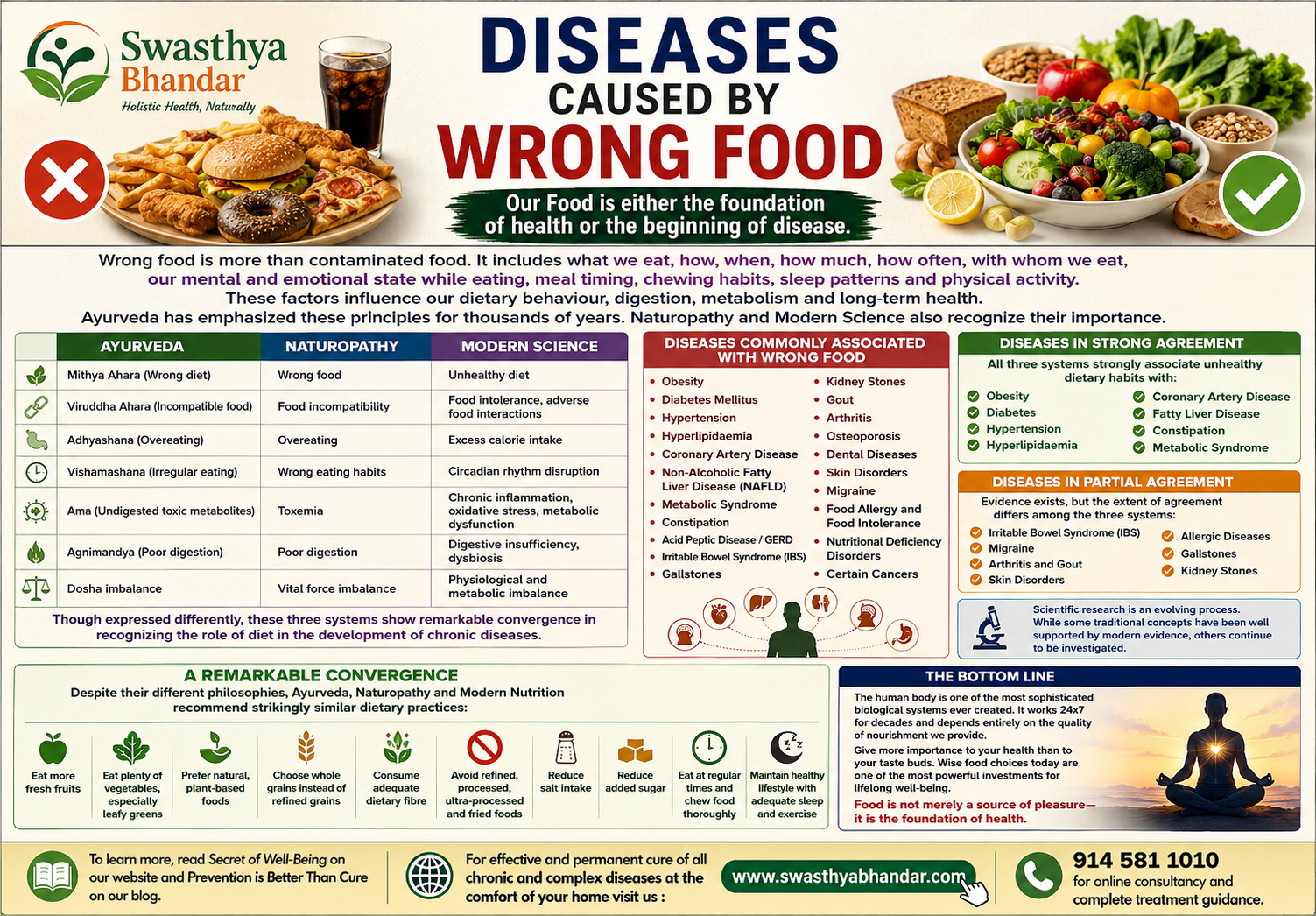
Our Food is either the foundation of health or the beginning of disease.
The term foodborne diseases is commonly used to describe illnesses caused by consuming food contaminated with bacteria, viruses, parasites, toxins, or harmful chemicals. These illnesses, often referred to as food poisoning, are usually acute and short-lived.
However, the concept of wrong food is much broader than contaminated food alone. It includes not only what we eat, but also how we eat, when we eat, how much we eat, how often we eat, with whom we eat, our mental and emotional state while eating, meal timing, chewing habits, sleep patterns, and physical activity. All these factors influence our dietary behaviour, digestion, metabolism, and long-term health.
Modern nutritional and behavioural research increasingly recognizes the importance of these lifestyle factors, while Ayurveda has emphasized them for thousands of years. Many dietary principles advocated by Ayurveda are also emphasized in Naturopathy, although the two systems evolved independently. Modern medicine, Ayurveda, and Naturopathy often use different terminology, yet many of their underlying concepts describe similar physiological and pathological processes.
Ayurveda | Naturopathy | Modern Science |
Mithya Ahara (Wrong diet) | Wrong food | Unhealthy diet |
Viruddha Ahara (Incompatible food) | Food incompatibility | Food intolerance, adverse food interactions |
Adhyashana (Overeating) | Overeating | Excess calorie intake |
Vishamashana (Irregular eating) | Wrong eating habits | Circadian rhythm disruption |
Ama (Undigested toxic metabolites) | Toxemia | Chronic inflammation, oxidative stress, metabolic dysfunction |
Agnimandya | Poor digestion | Digestive insufficiency, dysbiosis |
Dosha imbalance | Vital force imbalance | Physiological and metabolic imbalance |
Although expressed differently, these three systems show remarkable convergence in recognizing the role of diet in the development of chronic diseases.
Diseases Commonly Associated with Wrong Food
- Obesity
- Diabetes Mellitus
- Hypertension
- Hyperlipidaemia
- Coronary Artery Disease
- Non-Alcoholic Fatty Liver Disease (NAFLD)
- Metabolic Syndrome
- Constipation
- Acid Peptic Disease / GERD
- Irritable Bowel Syndrome (IBS)
- Gallstones
- Kidney Stones
- Gout
- Arthritis
- Osteoporosis
- Dental Diseases
- Skin Disorders
- Migraine
- Food Allergy and Food Intolerance
- Nutritional Deficiency Disorders
- Certain Cancers
The degree of agreement among Ayurveda, Naturopathy, and Modern Science varies.
Diseases in Strong Agreement
All three systems strongly associate unhealthy dietary habits with:
- Obesity
- Diabetes
- Hypertension
- Hyperlipidaemia
- Coronary Artery Disease
- Fatty Liver Disease
- Constipation
- Metabolic Syndrome
Diseases in Partial Agreement
Evidence exists, but the extent of agreement differs among the three systems:
- Irritable Bowel Syndrome (IBS)
- Migraine
- Arthritis and Gout
- Skin Disorders
- Allergic Diseases
- Gallstones
- Kidney Stones
Scientific research is an evolving process. While some traditional concepts have been well supported by modern evidence, others continue to be investigated.
A Remarkable Convergence
Despite their different philosophies, Ayurveda, Naturopathy, and Modern Nutrition recommend strikingly similar dietary practices:
- Eat more fresh fruits.
- Eat plenty of vegetables, especially leafy greens.
- Prefer natural, plant-based foods.
- Choose whole grains instead of refined grains.
- Consume adequate dietary fibre.
- Avoid refined foods.
- Avoid processed and ultra-processed foods.
- Avoid fried foods.
- Reduce salt intake.
- Reduce added sugar.
- Avoid overeating.
- Eat at regular times and chew food thoroughly.
- Maintain a healthy lifestyle with adequate sleep and regular physical activity.
The Bottom Line
The human body is one of the most sophisticated biological systems ever created. It works continuously—24 hours a day, 365 days a year—for decades. To perform this extraordinary task, it depends entirely on the quality of nourishment we provide.
Unfortunately, we often give greater importance to satisfying our taste buds than to meeting the nutritional needs of our body. This imbalance gradually paves the way for many chronic diseases.
Food is not merely a source of pleasure—it is the foundation of health. Making wise food choices today is one of the most powerful investments we can make for lifelong well-being.
To learn more, read Secret of Well-Being on our website and Prevention is Better Than Cure on our blog.
For effective and permanent cure of all chronic and complex diseases at the comfort of your home visit us : www.swasthyabhandar.com or contact 914 581 1010 for online consultancy and complete treatment guidance.